
Across mineral processing sites, one issue continues to show up: push-through knife gate valves are often used in applications where they do not belong. This happens because mining is treated as a single category, even though it actually includes two very different processing environments:
- Concentrate processing, where push-through knife gates can work well when used within their original design limits.
- Hydrometallurgical processing, which includes atmospheric leaching, solution mining, PAL, POL, and POx circuits—areas where push-through valves have a long history of failures, discharge problems, and environmental risks.
This article explains why these issues occur, where push-through valves still make sense, and why Guided Shear Gates (GSGs) are a better fit for most severe mining and hydromet applications. Throughout, one principle guides every selection: The application dictates the valve.
To learn more about how knife gate valves work in general, see our guide What Is a Knife Gate Valve?
The Real Issue with Valve Selection in Mineral Processing

Many valve problems in mineral processing occur not because valves are built poorly, but because a valve suited for one part of the industry is applied in another with very different demands.
Push-through knife gates can work in concentrated circuits, where:
- Slurries are neutral or slightly alkaline
- Pressures are low
- Cycle counts are minimal
Hydrometallurgical circuits are much harsher. Valves in these services face:
- Low pH acidic solutions
- Scale formation from dissolved solids
- Higher pressures and temperatures
- Frequent cycling
- ESG requirements that do not allow any discharge
Push-through valves were never designed for these conditions. When used in hydromet circuits, they often lead to:
- Early failure
- Increasing discharge as sleeves wear
- Leakage or spray during operation
- Unplanned shutdowns for sleeve replacement
- Ongoing safety and environmental risk
Guided Shear Gates were developed for these severe services. They keep all process media inside the valve body, cut through solids and scale, and provide tight bi-directional isolation without discharge. For valve solutions designed specifically for mining applications, see our Mining & Mineral Processing industry page.
How Push-Through Knife Gates Work
To understand why push-through valves behave the way they do, it helps to look at how they were originally designed to work.
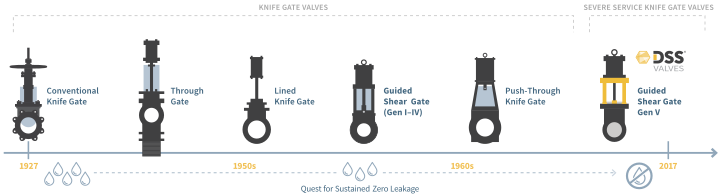
The first knife gate valves (from the pulp and paper industry in 1927) were inexpensive and suitable for fibrous solutions, but not for abrasive mineral slurries. In 1976, the push-through elastomer-sleeved knife gate specifically for mining. Its key features were:
- Two elastomer sleeves forming a full-bore lining
- A sharpened gate that separates the sleeves as it closes
- Elastic sealing: sleeves seal against the gate when closed and against each other when open
- A bottom discharge opening that releases a small amount of process media on every stroke
This design worked well in concentrated applications because:
- It protected the valve body
- Maintained a full, cavity-free bore
- Handled neutral or slightly alkaline tailings
- Produced relatively small discharge when sleeves were new
As sleeves wear or as pressure increases, discharge volumes increase noticeably. In neutral slurries, this may be acceptable but in acidic solutions it becomes a significant operational and environmental concern.
For a full breakdown of the different knife gate valve types used in industry, visit Types of Knife Gate Valves.
Why Push-Through Valves Fail in Hydromet and Leaching Circuits
Hydrometallurgical circuits are often the harshest places in a plant for valves. They combine low pH, high temperature, dissolved solids, and scale formation with the need to protect people, equipment, and the environment. In this world, the weak points of the push-through design become impossible to ignore.

1. Discharge as a Hazard, not a Feature
Push-through valves are often described as “packing-less” designs that purge solids by releasing media during each stroke. While acceptable in neutral slurries, this discharge becomes a problem in acidic or toxic services, every cycle becomes a small spill.
As sleeves wear, discharge increases. Higher pressures can cause continuous leakage even when the valve is open. In some plants, push-through discharge has drained noticeable volumes from pipelines during commissioning or operation.
2. Solids and Scale Build-Up
Leaching circuits commonly form gypsum or metal-sulphide scale. Push-through valves cannot cut through these solids, so scale collects inside the valve body and around the sleeves.
This leads to:
- Higher force required to stroke the valve
- Sleeve deformation
- Bent or damaged gates
- Valves sticking open or closed
Operators sometimes use excessive force or oversized actuators to move gates through compacted solids, which only increases damage.
3. ESG and Containment Costs
Modern hydromet plants cannot allow corrosive discharge to fall freely. Every drop must be captured, piped away, and treated.
This requires:
- Drain plates or chutes
- Additional piping, sumps, or launders
- Extra gaskets and hardware
- Handling and disposal procedures
In acidic service, these components often require corrosion-resistant materials, which removes any cost advantage of inexpensive valve body materials.
4. High Maintenance and Sleeve Replacement
Sleeve replacement is a major driver of operating cost in push-through valves. The sleeves are a large share of the valve’s price and must be replaced frequently when exposed to harsh conditions.
Maintenance manuals often require:
- Frequent spray lubrication of the gate
- Lubrication every 50–100 cycles
- Regular inspection and lubrication of secondary seals
- Strict storage conditions to protect sleeves
Most sites do not have the staff to maintain large numbers of valves at this level.
5. Pressure-Related Leakage
Push-through valves were originally designed for lower pressures. When used above their intended range, often above 150 psig leakage increases, and sleeve life drops sharply. Some designs require upgraded gates, yet still discharge significant volumes at higher pressures.
In hydromet circuits with high pressure, scale, and acidic slurries, push-through valves do not match the service requirements.
What Makes Guided Shear Gates Different

Guided Shear Gates (GSGs) were developed specifically for severe slurry and hydromet services. Unlike push-through valves, which rely on sleeves and a discharge port, GSGs are designed to isolate solids inside the valve without releasing process media.
Key advantages include:
- A guided gate that shears through suspended solids and scale
- Bi-directional zero-leakage isolation from precision sealing surfaces
- A closed body that contains all solids with zero external discharge
- High-pressure capability, including Class 1500 / PN 250 and above
In simple terms:
- Push-through valves expel process media to function.
- GSGs manage solids internally while maintaining full isolation.
In real plants, GSGs often achieve 10–20 times the service life of push-through valves in similar conditions. Some trial installations in hydromet tailings lines have remained in service for over 18 months and hundreds of cycles with minimal wear.
For a detailed look at modern GSG technology, visit the DSS Guided Shear Gate design page.1
Push-Through vs. Guided Shear Gate, A Practical Comparison
Based on more than 75,000 GSG installations and many side-by-side tests, a clear pattern emerges.
Push-Through Limitations
- Discharge occurs on every stroke and increases as sleeves age.
- Leakage in the open position can become continuous at higher pressures.
- Scale and solids build-up are not cut or cleared effectively.
- Drain plates and containment systems add cost and complexity in acidic services.
- Maintenance requirements are high: lubrication, sleeve inspection, and repeated replacements.
- Sleeves are expensive; replacing them frequently drives up operating cost.
- In severe hydromet applications, push-through valves often end up more expensive over their whole life than GSGs.
Guided Shear Gate Advantages
Class 1500 / PN 250 pressures (3750 psig/250 barg)
- No external discharge on any stroke.
- Bi-directional zero-leakage isolation suitable for both neutral and acidic duties
- Guided gate can shear through precipitated scale and suspended solids.
- High pressure capability, with designs proven up to Class 1500 / PN 250.
- Long service life in harsh conditions; often 15–30 times the life of poorly-applied push-through valves.
- Lower maintenance cost and fewer unplanned shutdowns.
- Better alignment with ESG expectations because process media remains contained.
Key Indicators You Are Using the Wrong Valve
From the field experience summarized in the whitepaper, several simple indicators suggest that a push-through valve may be misapplied:
- Discharge volumes are growing, or leakage is now continuous.
- Drain plates or chutes are constantly wet, corroded, or plugged.
- Sleeves are replaced far more often than expected.
- Operators rely on force or oversized actuators to stroke the valve.
- Scale and solids inside the valve are a routine problem.
- Maintenance teams regularly pull valves for repair on the same lines.
- Environmental or safety teams are concerned about spray, spills, or acid exposure near valves.
When these symptoms appear, the problem is usually not the quality of the push-through valve, it is that the application demands a different technology.
Conclusion
Push-through knife gates work well in neutral, low-pressure concentrate services, but they are not suited for hydrometallurgical duties. In acidic, scale-forming, or high-pressure applications, their discharge and sleeve wear create reliability, safety, and environmental problems.
Guided Shear Gates (GSGs) were designed for these severe conditions. They contain all process media, cut through solids and scale, and provide long, stable service life. Across real plant data, GSGs consistently perform better in demanding slurry applications.
Simply put: the application dictates the valve, and in most severe mining and hydromet services, that means choosing a Guided Shear Gate.
If you’re unsure what valve is right for your service, contact CGIS for specification support. We can help you choose the correct valve for your mineral processing application.