
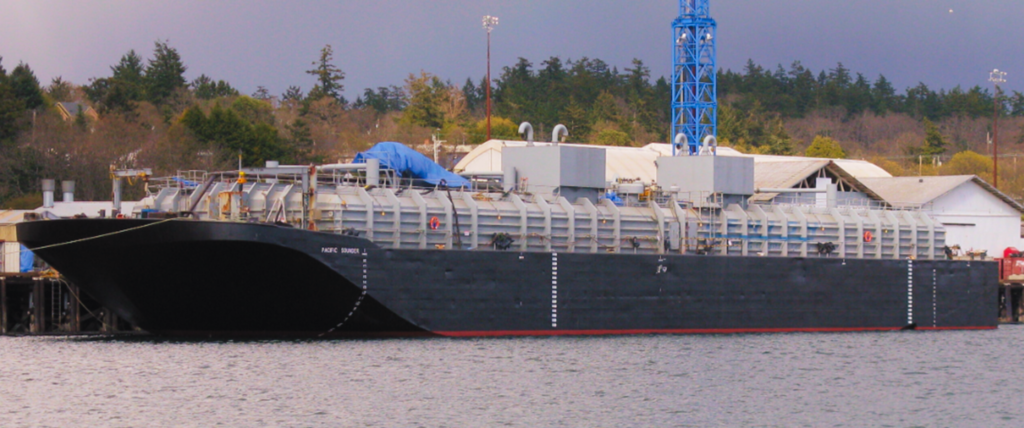
Heidelberg Materials operates the Pacific Sounder barge to transport dry cement powder between Delta, BC, and Bellingham, Washington. Central to this operation is a DN600 (24”) main fill valve, supported by several DN250 (10”) valves that distribute the cement powder for proper balance during transit.
For years, this valve position had been a high-maintenance point until CGIS helped identify a longer-lasting solution.
The Problem: Frequent Valve Failure in a Demanding Application
The barge originally relied on a resilient-seated butterfly valve with an EPDM liner, which in theory should have provided a reliable shutoff for dry powder handling. In practice, it lasted only 3–4 months before failure.
Three key issues shortened the valve’s lifespan:
- Seat wear from abrasive cement powder
- Build-up that caused sticking and eventual seizure
- A challenging installation environment inside a confined barge compartment
Because the vessel was constantly relocating and the valve size was substantial (DN600), each replacement resulted in significant downtime and high costs.
The Solution: A Valve Built for Abrasive Media
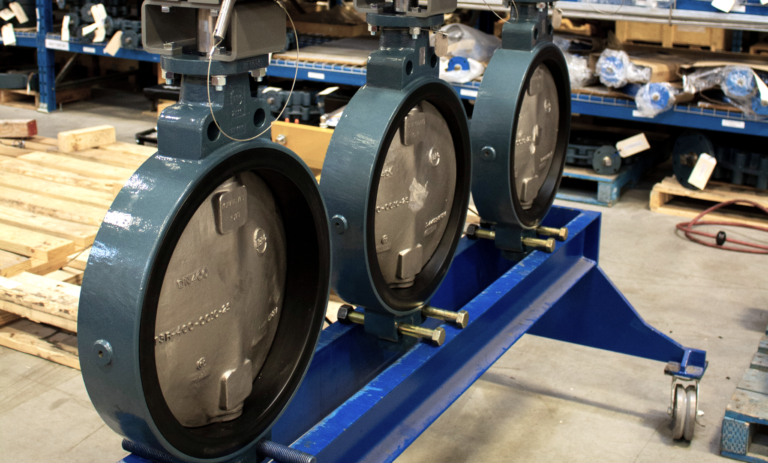
CGIS analyzed the failure pattern and recommended a more durable option: the Ebro Armaturen Z011A butterfly valve, a design well-suited to abrasive, dry powder applications.
This design provided several advantages:
- A continuous forming lobe liner that locks into a machined body groove, reducing movement and wear
- An upgraded NBR-HAR seat, a highly abrasion-resistant elastomer ideal for dry, abrasive media
- A ductile iron body and 316 stainless steel discs, improving corrosion resistance and rigidity
This configuration significantly reduced the effects of powder abrasion and seat damage that plagued the previous valve.
The Results: 2–3× Longer Service Life and Reduced Downtime
After upgrading to the Ebro Z011A, Heidelberg Materials achieved a significantly more reliable and efficient operation. This improvement becomes clear when comparing performance before and after the change:
| Before (Previously Installed Valve) | After (Ebro Z011A) |
|---|---|
| 3 to 4 months of service life | 8 to 12 months of service life |
| Frequent seat wear and sticking | Reduced wear with stable, consistent operation |
| Multiple changeouts per year | Far fewer replacements needed |
| High downtime and maintenance cost | Lower maintenance burden and improved scheduling |
Overall Result: A 2–3× increase in valve lifespan and a smoother, more predictable operation for the Pacific Sounder barge.
For more context on valve performance in severe service applications, see: Defining Severe Service Valves.
Conclusion
By understanding the root cause of repeated valve failures and matching the application with the right materials and design features, CGIS delivered a solution that dramatically improved reliability on the Pacific Sounder. The Ebro Z011A now provides Heidelberg Materials with predictable, longer-lasting performance and reduced total cost of ownership.
Talk to a CGIS valve specialist today to find the best solution for your application.
To explore more case studies, visit our Article Library.